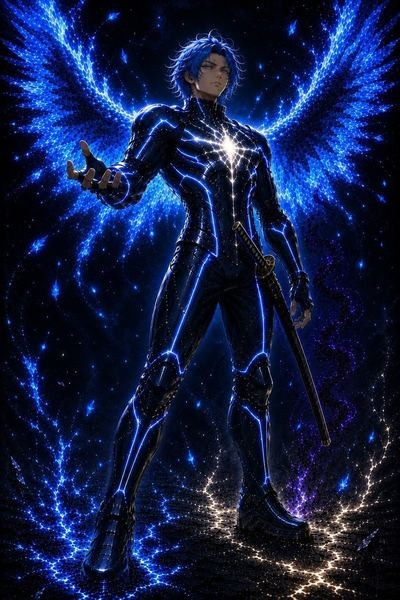
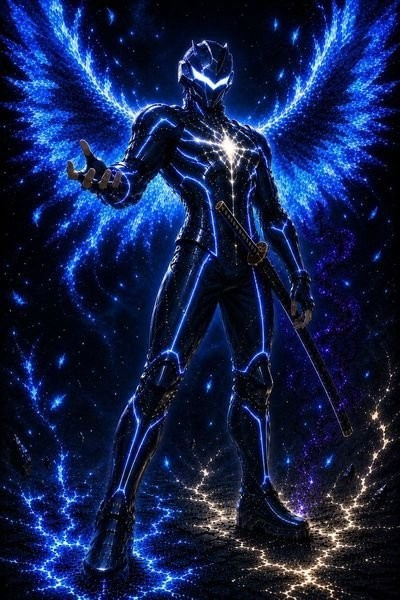


The first thing he saw in that place was his own chest.
Not the wound. The light. White flame leaking through his sternum in the reflection of a steel wall — cold, clinical, precise. A Germa facility doesn't have mirrors. It has surfaces flat enough to be honest, and the honesty was this: Rokuji was not healing. He was burning inward, and he didn't know how to stop.
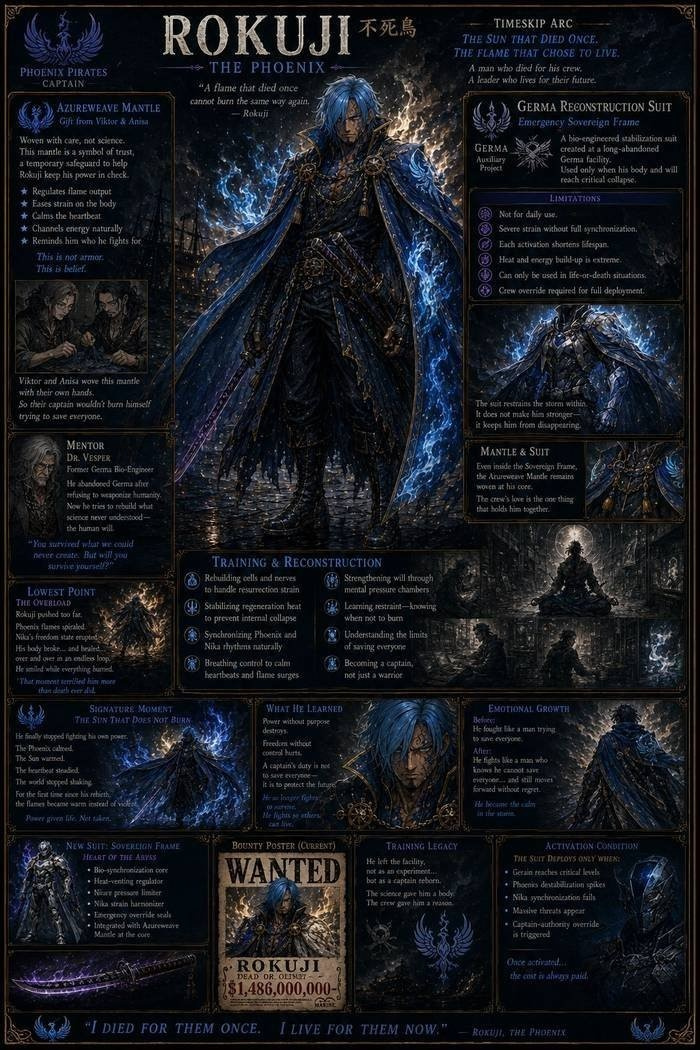
Dr. Vesper never called him The Phoenix. In eighteen months, not once. Just his name, spoken the way you'd say the name of someone you were trying to keep from disappearing. It mattered more than Rokuji admitted.
"You're not fighting your power," Vesper said on the third week, reviewing readouts Rokuji didn't understand. "You're fighting yourself. Your body resurrected. Your will kept you here. The problem is that Phoenix and Nika are both your will, and you've convinced yourself they're at war."
Rokuji said nothing. He'd been saying nothing for three weeks. That was its own kind of symptom.
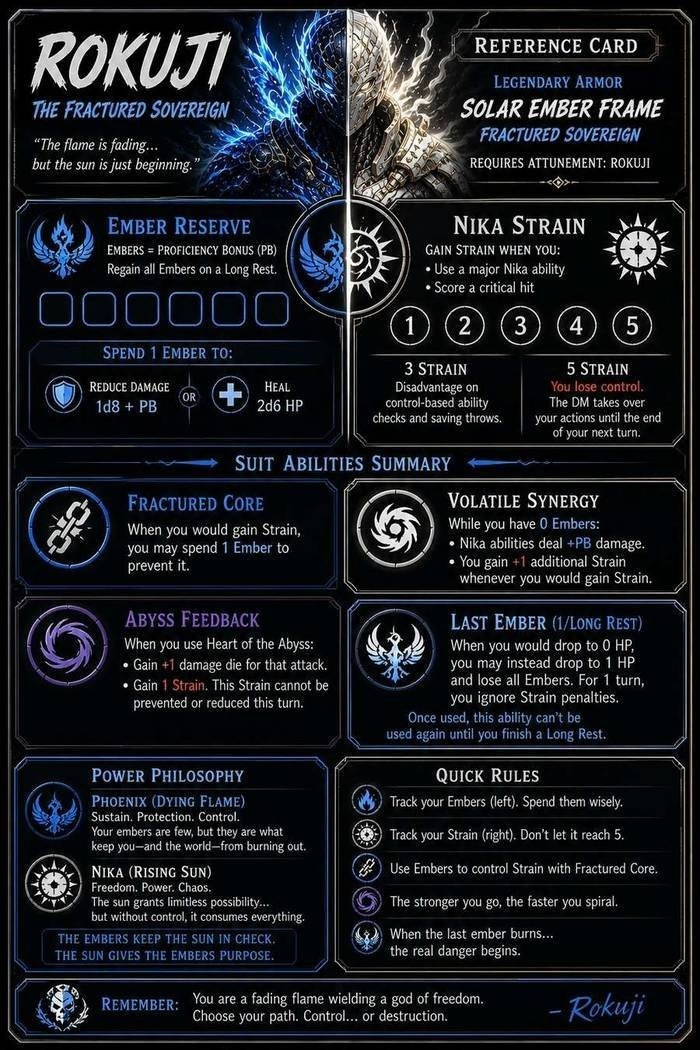
The training was not combat. It was the opposite — stillness, breathing, the slow and maddening work of letting the Phoenix exist without directing it. Every cell that had been rebuilt by resurrection carried a memory of fire. The Nika side carried something older, stranger. Something that had broken through at Marineford in the worst possible way and hadn't fully gone back.
Month four was when it broke open.
He pushed too far. Both forces at once — Phoenix for heat, Nika for freedom — and the result was not power. It was collapse. His body broke and healed and broke again in a loop his mind couldn't interrupt. He lay on the floor of a sterile room watching his hands catch fire and reconstruct and catch fire again, and somewhere in that endless cycle he found himself smiling.
That was the part that terrified him. Not the pain. The smile.
Vesper found him six hours later. Said nothing. Sat beside him until the loop finally exhausted itself. Afterward, in the silence, Rokuji asked: "Is that what I look like when I'm not in control?"
"That," Vesper said, "is what you look like when you're still trying to be."
The turn came on an ordinary morning.
He wasn't training. He was sitting in the room they'd given him, watching light come through a porthole. He wasn't trying to control the Phoenix. He wasn't bracing for Nika. He was thinking, for the first time in years, about something small — the way the crew used to eat together on the Miku before everything. Bon arguing over portions. Finn cheating at cards. The particular sound of the ship.
The flame in his chest went warm.
Not violent. Not leaking. Warm — the way a hearth is warm, not a wildfire. He put his hand to his sternum and felt it pulse steady, and for the first time since Marineford, the Phoenix was not something he was managing. It was simply there. Part of him.
He sat very still for a long time.
When he finally told Vesper, the doctor just nodded. "There it is." He pulled out his notes, set them aside, and looked at Rokuji directly. "You stopped fighting to survive. Yes?"
"Yes."
"Why?"
Rokuji was quiet. Then: "Because surviving isn't the point. They're still out there. The crew. They scattered because I wasn't strong enough to protect them. I need to be able to make sure that when we find each other again, it doesn't happen a second time." He paused. "That's not about surviving. That's about what surviving is for."
Vesper made no comment. He closed his notebook.
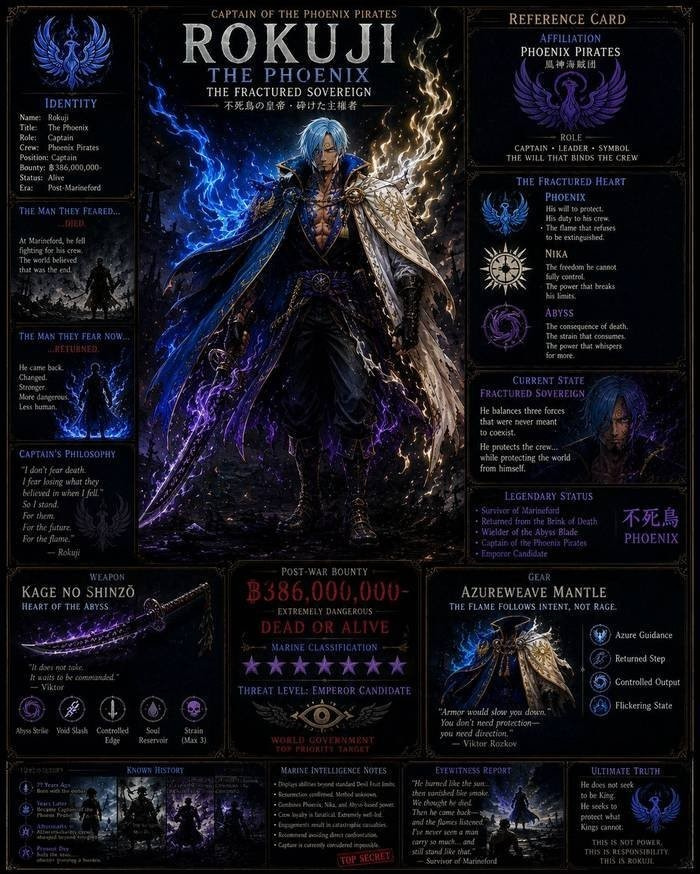
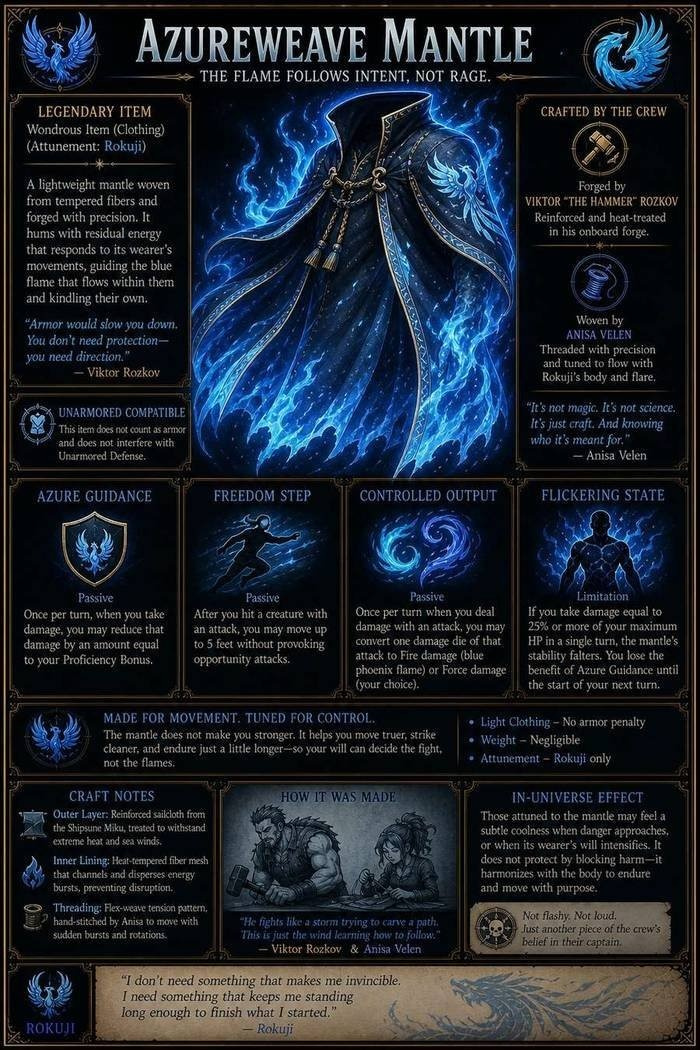
Viktor and Anisa's Azureweave Mantle arrived by courier at month eleven. No note — just the Miku's shipwright seal on the crate. Rokuji held the fabric and felt the craft in every thread, the way it moved with intention rather than resisting it.
He wore it in the facility's empty training hall and stood in the center for a while.
Then he began practicing — not to control the fire. To carry it. The difference was everything. The Sovereign Frame arrived at month fifteen. Emergency use only. Vesper's condition, not his preference. Rokuji agreed without argument. He'd learned the difference between power and purpose.
He left the facility in the early morning without telling Vesper he was going. The doctor was already awake when he reached the door.
"You're late," Vesper said, not looking up from his desk. Just his name. Just that. The way you'd say it to someone you were glad to see leave — because they had somewhere to be.
---