The Tide Hermit stole his ship while he was sleeping.
Kaillou woke to open water and fog so thick he couldn't see the bow from the stern. His sextant read nothing — stars erased mid-sky, Log Pose spinning loose, compass pointing to a direction that didn't correspond to any chart he carried. His ship was gone. In its place was a battered vessel maybe a third the size, with a single sail and a note tacked to the mast in handwriting that looked like tide marks:
You won't need the charts. You never did.
The Silent Meridian didn't appear on any map because no map could hold it. Log Poses pointed to nothing there because the islands didn't want to be found. Kaillou spent the first three weeks rebuilding his understanding of where he was from first principles — current temperature, wave frequency, cloud formation, the behavior of birds he'd never seen. He took notes. He filled a journal. Then he threw the journal overboard, because the Hermit found it and said nothing, but the look was sufficient.
"Memory is not the same as understanding," the old man told him. "You have too much of one and not enough of the other."
Month five, Kaillou led three salvaged ships he'd gathered during the crossing into what looked like navigable water. He had read the currents. He had checked the cloud formations. He had been precise.
The maelstrom took all three ships in under four minutes.
He watched from the Hermit's vessel, clinging to the rail, and felt the instruments in his coat become meaningless dead weight one by one. Log Pose: useless. Sextant: nothing to align to. Charts: not even wrong — just irrelevant. The sea did not care about his precision.
He did not speak for two days after.
On the third day he began again — but differently. Not charting. Feeling. The pressure beneath the hull, the particular resistance of water moving against water, the way the Hermit's ship responded to depth without him steering it. He started understanding what the sea remembered about a place even when the surface told a different story.
The forge came at month nine, and it was the Hermit's idea.
There was iron in the Silent Meridian — black deposits in a seamount that broke the surface only at low tide. The Hermit had been hoarding it for years, waiting. He told Kaillou what it was: iron that had grown in current, shaped by the pressure of the deep. It moved with the sea's grain rather than against it. He had never found anyone worth wasting it on.
"You'll do the work," the Hermit said. "I'll tell you when you're wrong."
Kaillou had no formal smithing experience. That was the point. Raizen Kurogane's name was spoken once during the process — the Hermit mentioned him sideways, the way old men mention rivals — and Kaillou understood that the Hermit's method was the opposite. Raizen forged intent into iron. The Hermit wanted iron shaped by patience. Same material. Different answer.
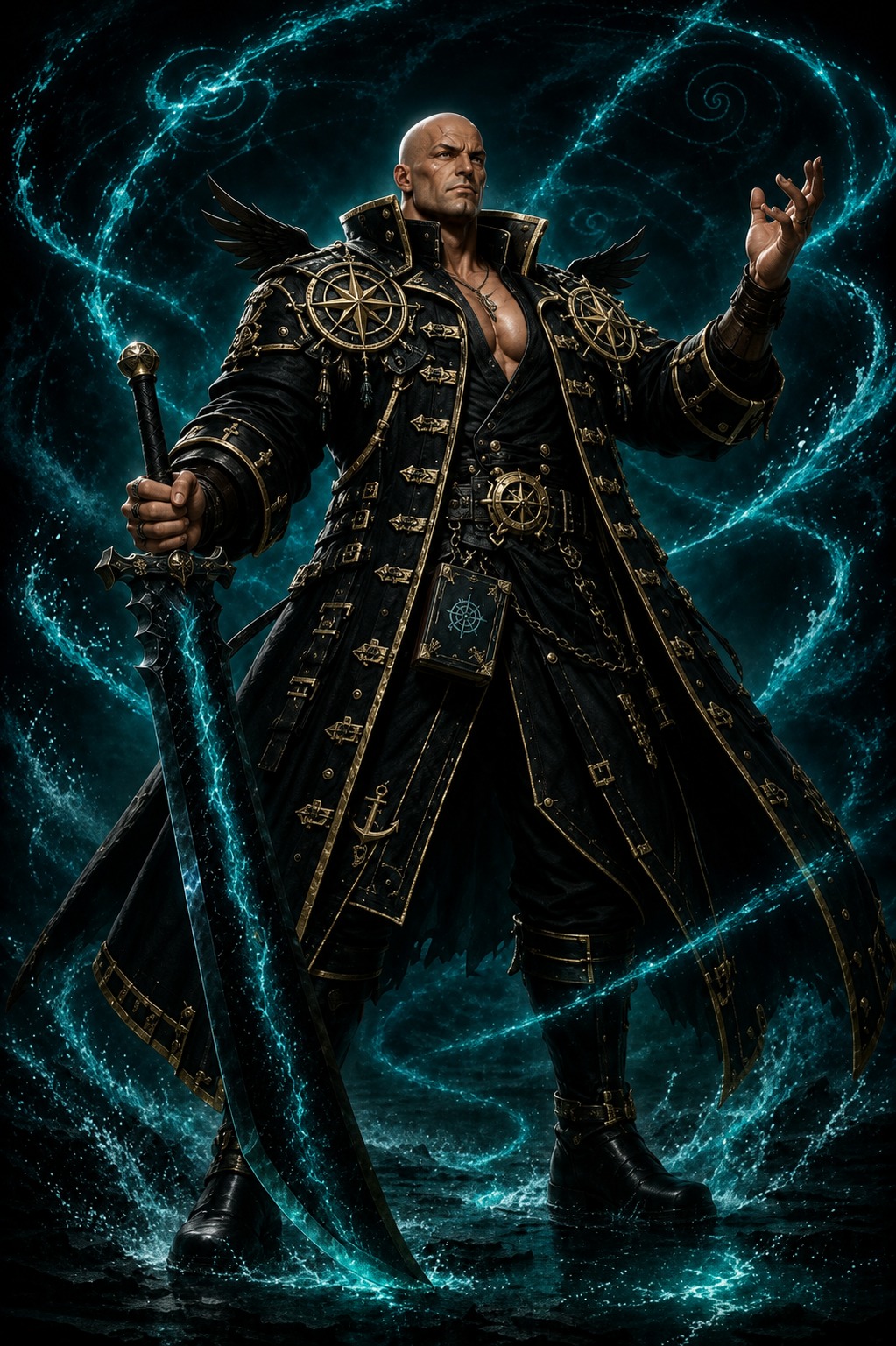
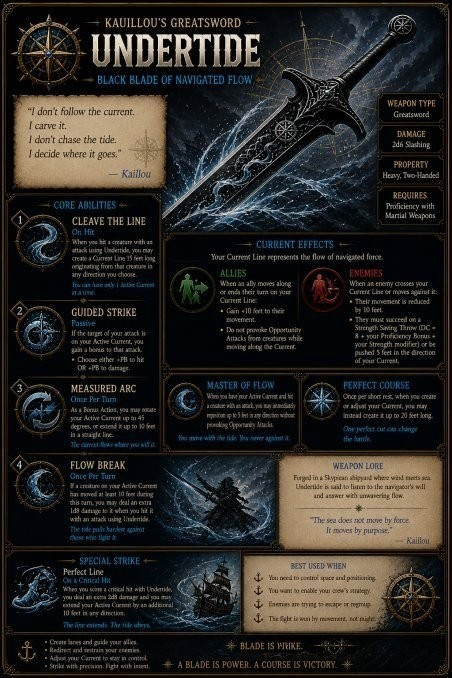
The blade took six weeks. Kaillou broke four attempts before finding the angle — the way to fold the iron so it carried the grain of deep current without fracturing. Undertide came out black and heavy and absolutely still in the hand, like holding a piece of the seafloor. The edge didn't shine. It absorbed.
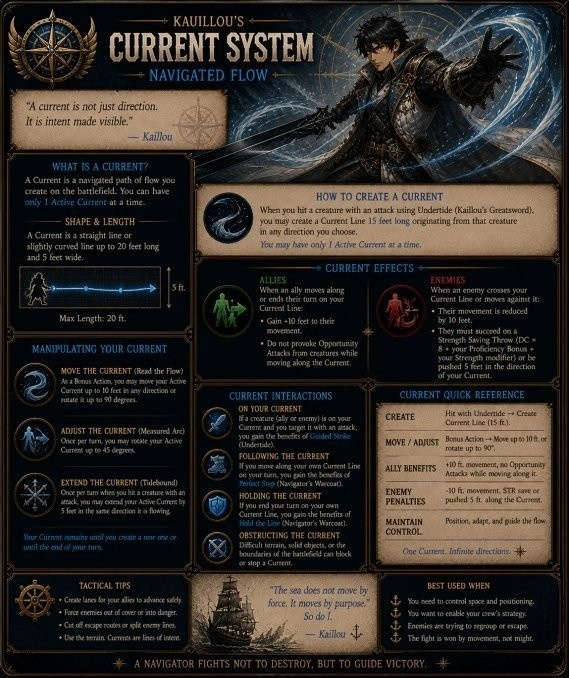
When the first Current Line appeared off a practice strike — fifteen feet of presence hanging in the air where the blade had passed — Kaillou stood and stared at it for a long time.
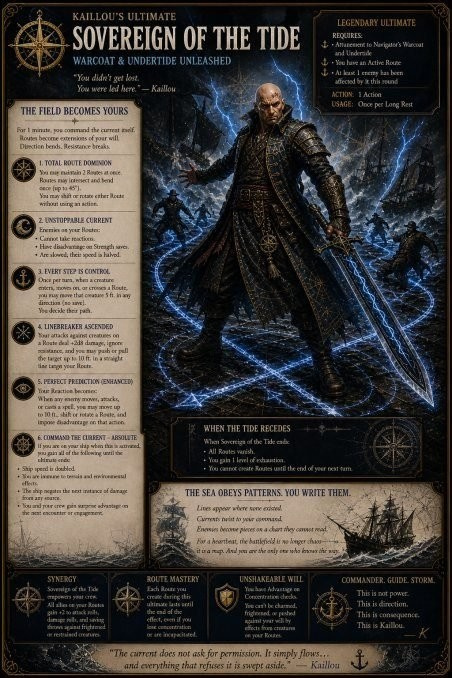
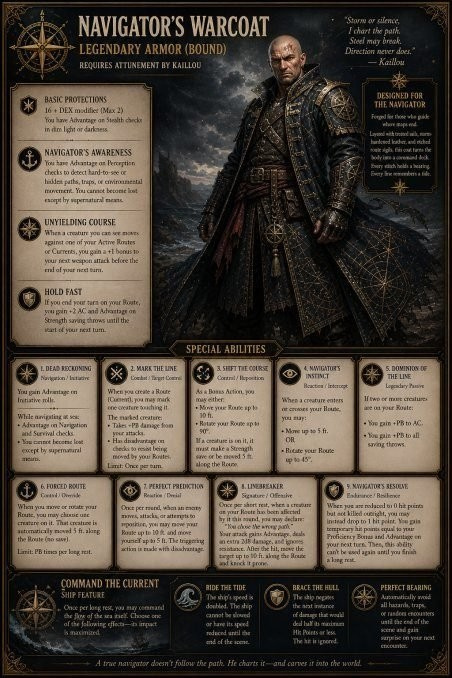
The Warcoat came from the observatory hold, packed in oilskin, untouched. The Hermit pulled it out without ceremony and dropped it on Kaillou's bunk.
"I've had that fifty years. It's for whoever learns to navigate without needing to." He paused. "I suppose that's you now."
The Final Test arrived without announcement. Kaillou simply woke one morning to find the Hermit standing at the wheel in a storm that had erased the sky. No stars. No Pose. The Hermit stepped aside and said nothing.
Kaillou took the wheel.
He felt the current through the hull. Not with instruments — with his hands, his feet, the way the ship breathed under pressure. He brought them through in silence, adjusting by fractions of feeling he couldn't have named two months before.
The fog broke on open water. Clear sky. The Hermit stood at the stern with his hands behind his back and nodded once.
That was his only compliment.
Kaillou wrote one line in his new log that night: The sea has memory. I just learned to read it.
He kept that journal. The Hermit didn't say anything about it. That meant it was earned.
---